AI Development


- AI Services
-

-
 Generative AI
 -
 Data Engineering
 -
 ML Development
 -
 AI Consulting Services
 -
 Chatbot Development
 -
 Computer Vision
 -
 Enterprise AI Development
 -
 AI Agent Development
 -
 LLM Development
 -
 NLP Services
 -
 RAG as a Service
 -
 AI Integration Services
 -
 AI Automation Agency
 -
 Deep Learning Development
 -
 AI Voice Agent Development
 -
 LLM Fine-Tuning
 -
 Enterprise AI Chatbot
 -
 Vibe Coding Agency
 -
 Business Intelligence Services
 -
 AI Workflow Automation
 -
 AI Visual Inspection Development
 -
 Generative AI Consulting
 -
 AI PoC Development
 -
 AI MVP Development
 -
 AI Implementation Services
 -
 Mobile App Development
 -
 SaaS App Development
 -
 E-commerce Development
 -
 Web Development
 -
 Software Development
AI Services
AI-Powered Engineering Services
-
- Industries
-
 AI Solutions for FintechMerging AI technologies with
finance and financial services -
 AI Solutions for LogisticsWe build AI solutions for
Logistics service providers -
 Healthcare AI SolutionsWe build AI-powered
healthcare solutions. -
 Retail AI SolutionsGet robust retail AI solutions built
with the latest smart retail features. -
 AI Solutions for EcommerceWe build AI-powered solutions
for Ecommerce Businesses. -
 AI Solutions for AutomotiveWe Develop AI-Powered Solutions
for Automotive Businesses. -
 AI solutions for travelBuild AI- powered travel app
with all travel essential features -
 AI Solutions for EducationBuild an AI-powered EdTech app
that's fun, instructive, and insightful. -
 Real Estate AI SolutionsGet AI solutions for real estate
business built with the latest features. - Hire AI Developers
-
 AI Developers
 -
 Gen AI Engineers
 -
 Data Engineers
 -
 ML Engineers
 -
 Vibe Coding Experts
 -
 Python Developers
 -
 Hire Data Scientists
 -
 Prompt Engineers
Artificial Intelligence (AI) Engineers
-
- Case Studies
- Resources
- Company
-
-
-






Table of Contents
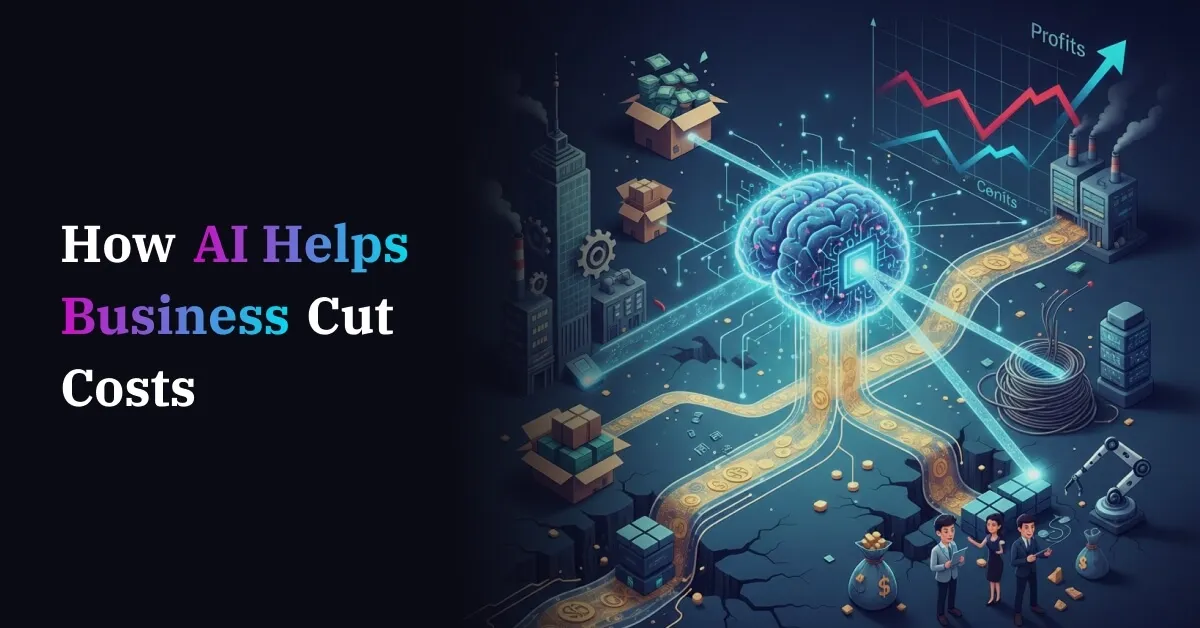
How AI Helps Businesses Cut Costs: A Practical Guide to Smarter Savings
Key Takeaways
- AI helps businesses reduce operational costs by 20 to 30 percent through automation, error reduction, and streamlined workflows.
- Labor, maintenance, inventory, compliance, and marketing are key areas where AI delivers fast and measurable savings.
- Predictive AI lowers downtime and waste by identifying issues early in operations, equipment, and quality control.
- AI tools improve marketing efficiency by optimizing ad spend, personalizing campaigns, and reducing team size needs.
- Off-the-shelf AI solutions allow businesses to start small with low upfront costs and scale adoption across departments.
- Measuring AI ROI requires tracking cost savings, reduced labor hours, and cycle time improvements from day one.
Businesses everywhere are feeling the pressure. Labor costs keep climbing. Supply chains face constant disruption. Competition is faster and sharper than ever. In this environment, every dollar saved matters, and that’s exactly where Artificial Intelligence is changing the game.
AI is no longer a futuristic tool reserved for tech giants. It has become a practical cost-cutting engine that organizations of all sizes can use to run smarter, leaner, and more efficiently. Companies that adopt AI and automation solutions can reduce operational costs by 20–30% while improving efficiency by more than 40%, making AI one of the most impactful tools for financial and operational optimization today. Companies that once relied on manual work and slow decision-making now use AI to automate routine tasks, reduce errors, and forecast problems before they become expensive setbacks. The impact is real. Many firms are already reporting noticeable drops in operational expenses within the first months of AI implementation.
But this movement isn’t driven by hype. It’s driven by results. CFOs, CEOs, and operations leaders are betting on AI because it turns data into efficiency, inefficiencies into savings, and time-consuming tasks into fully automated workflows. The message is clear: businesses that adopt AI effectively can cut recurring costs while increasing productivity at the same time.
The natural question, however, still stands: How does AI actually help a business reduce costs, and what does it take to get there?
This guide walks you through those answers with real examples, practical insights, and clear steps you can apply right away.
Table of Contents
Why Businesses Are Turning to AI for Cost Savings
Running a business today means battling rising labor costs, inefficient operations, wasted resources, and expensive downtime. Leaders are looking for solutions that reduce cost without slowing growth.
The pressure to save is real
Manual processes drain time and money. Traditional cost‑cutting methods like hiring freezes and layoffs offer short relief but damage long‑term performance.
AI delivers measurable savings
ARDEM reports that companies using AI for business process automation are reducing operational costs by 20 to 30 percent, especially when repetitive workflows are automated. These savings happen fast because AI replaces slow tasks and eliminates errors.
Cost leadership through innovation
BCG highlights that top organizations are using AI to gain a permanent cost advantage, not just temporary savings. They reduce downtime, accelerate production, and optimize supply chains to stay ahead of competitors.
From reactive cuts to proactive intelligence
Instead of responding to problems after they occur, AI forecasts them before they become costly. Every decision becomes faster, more accurate, and more cost‑efficient.
Top 6 Business Areas Where AI Cuts Costs
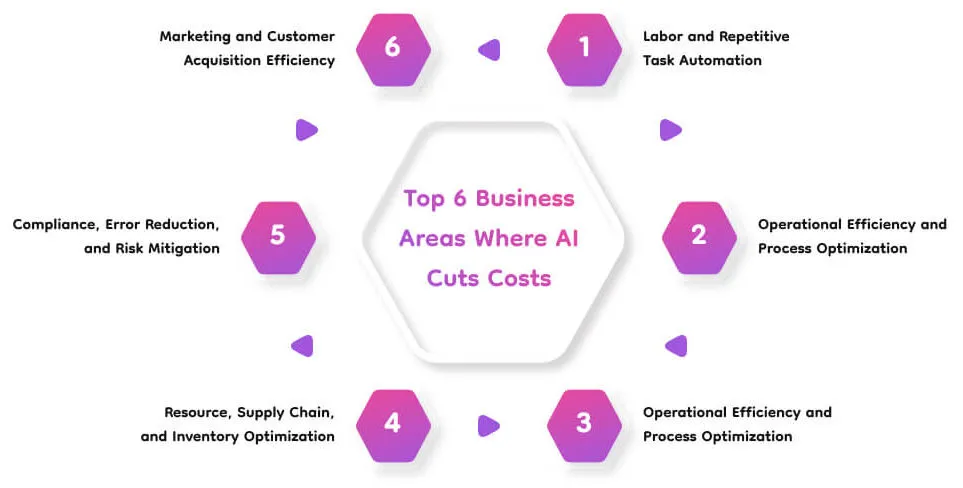
AI isn’t a one-size-fits-all solution. Its real power lies in how it fits into different areas of a business, unlocking savings where inefficiencies hide. Below are the top functions where AI delivers quick and measurable cost reductions.
1. Labor and Repetitive Task Automation
Many businesses still rely on people to handle routine, time-consuming tasks think data entry, ticket routing, and invoice processing. AI handles these faster, more accurately, and without fatigue.
Tools like chatbots, virtual assistants, and workflow automation reduce the need for manual intervention in customer service and back-office operations. According to IntelePeer, AI in contact centers alone can slash labor costs by as much as 30%.
Key savings: Fewer errors, lower full-time employee (FTE) costs, and faster turnaround on repetitive tasks.
2. Operational Efficiency and Process Optimization
AI helps businesses run smoother by identifying and fixing process gaps before they turn into costly problems. It uses real-time data to streamline workflows, reduce delays, and automate decisions.
Cost-saving benefits:
- Eliminates labor-heavy, repetitive tasks that slow operations
- Minimizes rework caused by human error
- Uses predictive analytics to optimize daily workflows
- Frees up teams to focus on strategic, high-value work
- Reduces overhead tied to inefficient systems
3. Maintenance, Downtime, and Quality Control
Unexpected downtime is expensive, especially in manufacturing, logistics, and equipment-heavy industries. AI-powered predictive maintenance systems spot issues before machines break down, using advanced ML development to reduce downtime and repair costs.
Nanotronics highlights how AI not only improves uptime but also enhances product quality through intelligent monitoring. This reduces waste, returns, and the cost of fixing defects after production.
Key savings: Fewer breakdowns, less scrap, and higher output without additional resource costs.
4. Resource, Supply Chain, and Inventory Optimization
Inventory issues can silently drain profit. Overstocking ties up capital. Understocking leads to lost sales. AI helps fix this by forecasting demand more accurately, analyzing trends, and adjusting stock levels in real time.
Nanotronics explains how AI-powered supply chain systems reduce waste, speed up logistics, and prevent resource misallocation. It helps companies keep just the right amount of stock no more, no less.
Key savings: Lower inventory holding costs, reduced supply chain disruptions, and smarter resource use.
5. Compliance, Error Reduction, and Risk Mitigation
Compliance mistakes aren’t just expensive, they can damage your reputation. AI helps prevent them by automating oversight, catching errors early, and maintaining consistent documentation.
Cost-saving benefits:
- Automates compliance checks to reduce human error
- Flags inconsistencies in real time before they escalate
- Tracks regulatory changes to keep processes up to date
- Speeds up internal audits with AI-driven document analysis
- Reduces reliance on large compliance teams
- Minimizes legal risks from missed deadlines or incorrect filings
- Cuts costs tied to non-compliance fines and investigations
6. Marketing and Customer Acquisition Efficiency
AI is reshaping how businesses approach marketing by eliminating guesswork and focusing on data-driven decisions. It helps cut campaign costs while improving targeting and performance.
Cost-saving benefits:
- Optimizes ad spend by targeting high-converting audiences
- Automates A/B testing to improve results without extra manpower
- Personalizes email, content, and offers to increase conversion rates
- Reduces reliance on large marketing teams through AI-generated content
- Tracks campaign performance in real time to avoid budget waste
How Much Does It Cost to Implement AI in Your Business and How Much ROI Could It Give You?
Before diving into any AI project, most leaders ask two things: What’s the cost? and Is it worth it? The good news is, AI offers real ROI but only when applied smartly and tracked clearly.
How much AI integration could cost?
The total investment can vary widely based on scope, scale, and customization.
According to Nanotronics, basic off-the-shelf AI tools may cost as little as a few thousand dollars, while large-scale, tailored systems can reach six figures or more.
Typical cost components include:
- Software and licensing fees
- Data cleaning and integration
- Internal training and change management
- Ongoing maintenance or cloud hosting
For most mid-sized businesses, AI adoption can start small and scale up without breaking the budget.
How to track ROI from AI
You can’t improve what you don’t measure. Tracking ROI from AI means defining clear metrics and monitoring them consistently.
Key metrics to track:
- Cost savings (monthly or quarterly)
- Manual labor hours reduced
- Error rates before and after implementation
- Cycle time improvements (task or process speed)
- Resource utilization (people, systems, time)
- Customer or employee satisfaction (if applicable)
A simple ROI framework to follow
Here’s a 4-step framework to measure your AI ROI clearly:
- Identify your baseline: How much time, money, or resources are currently spent on the process?
- Define your goals: What % reduction or time-saving do you expect after AI implementation?
- Track improvements: Measure the same KPIs post-launch weekly, monthly, or quarterly.
- Iterate as needed: Fine-tune the AI model or expand it to new areas once it proves its value.
Example: What real ROI could look like
Let’s say your finance team spends 300 hours a month on manual invoice processing.
- You implement an AI-based automation tool.
- Manual effort drops by 30% (saving 90 hours/month).
- That’s 1,080 hours saved per year.
- If your average hourly labor cost is $40, that’s $43,200 saved annually and that’s from one process.
Add reduced error rates and faster cash flow into the equation, and the ROI stacks up quickly.
You Might Like to Read:
Game-Changing Impacts of Parallel AI on Business Performance
How to Implement AI in Your Business?
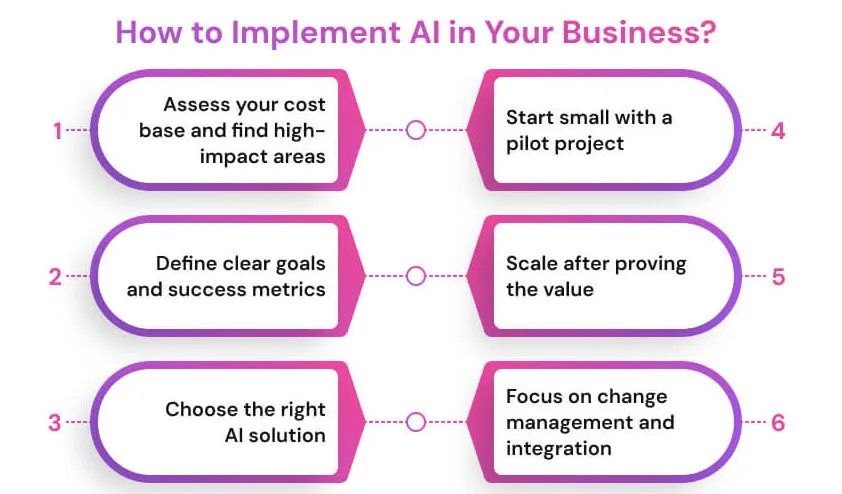
Implementing AI doesn’t need to be complex. Follow these steps to move from idea to real cost savings with clarity and confidence.
Step 1: Assess your cost base and find high-impact areas
Identify areas with high manual workloads, recurring errors, or wasted time. These are your biggest cost drains and best opportunities for AI workflow automation. Focus on workflows that are repetitive, measurable, and tied to business outcomes.
Step 2: Define clear goals and success metrics
Set measurable targets like reducing processing time, cutting error rates, or saving labor hours. Clarity here ensures you can track progress and prove ROI when it matters.
Example: Reduce invoice processing time from 3 days to 1 day within 60 days.
Step 3: Choose the right AI solution
Off the shelf tools are faster and more affordable, while custom solutions offer flexibility for complex needs. Match the tool to your process, budget, and internal capabilities to ensure sustainable adoption.
Example: Use an off the shelf chatbot for customer support, but a custom model for fraud detection.
Step 4: Start small with a pilot project
Pick a single process with low risk and high visibility to test your AI tool. Run it, gather data, and monitor outcomes from day one. A well-documented pilot makes it easier to get stakeholder buy-in later.
Step 5: Scale after proving the value
If the pilot delivers ROI, expand to other departments or processes. Prioritize areas with similar challenges for faster implementation. Keep refining your approach with each rollout.
Step 6: Focus on change management and integration
Your people make or break AI adoption. Involve key teams early, explain how AI will help, not replace them, and integrate solutions smoothly into existing workflows to avoid disruption.

Conclusion: Turning AI Into a Cost-Saving Advantage
Did you see? it’s clear that AI isn’t just a future trend, it’s a proven strategy for cutting costs, improving efficiency, and gaining a competitive edge. From automating repetitive tasks to optimizing operations and reducing errors, AI helps you spend less while doing more.
Whether you’re starting with one workflow or planning a full digital transformation, the key is to move with focus, track results, and scale what works.
If you’re ready to explore AI solutions tailored to your business, our team at Prismetric is here to help. We specialize in building cost-effective, intelligent systems that drive real results.
Get in touch today to speak with a consultant and discover how AI can save you money, starting now.
Frequently Asked Questions
1. How can AI help my business save money?
AI helps reduce costs by automating repetitive tasks, minimizing errors, improving decision-making, and streamlining operations. AI can replace manual processes with faster, more accurate systems that require fewer resources.
2. What is the average ROI of implementing AI in a business?
The ROI varies, but many businesses see a 20–30% reduction in operational costs within the first year. Savings come from lower labor costs, improved efficiency, and better resource allocation.
3. Is AI implementation expensive for small or mid-sized businesses?
Not necessarily. You should know that many AI tools are affordable and scalable. Off-the-shelf solutions can start with a low upfront cost, allowing smaller businesses to test and grow without a major investment.
4. Which business functions benefit most from AI cost savings?
Operations, customer service, supply chain, finance, and compliance are often the first to benefit. These areas typically involve repetitive tasks or high-volume data, making them ideal for automation.
Although AI is not limited to these areas, any area/field that has repetitive tasks AI can automate that.
5. How long does it take to see cost savings after using AI?
You can see early results in as little as 2 to 3 months, especially when starting with a well-defined pilot project.
Your long-term savings increase as AI scales across more departments.

Vijay Chauhan is a pro vibe coder with a passion for AI development and innovation. With deep expertise in crafting smart tools, he knows how to make AI dance to the rhythm of natural language. Always eager to share knowledge, Vijay blends tech mastery with creativity to build next-gen AI experiences.
Our Recent Blog
Know what’s new in Technology and Development
14+Years’ Experience in IT
Prismetric Success Stories
0+
Happy Clients
0+
Solutions Developed
0+
Countries
0+
Developers